Role
Spec, web app, database
QR table ordering for a cafe where guests pay on the way out. Each table orders in rounds onto one shared bill that staff follow on a live board, and the owner runs the menu and membership plans from an admin console.
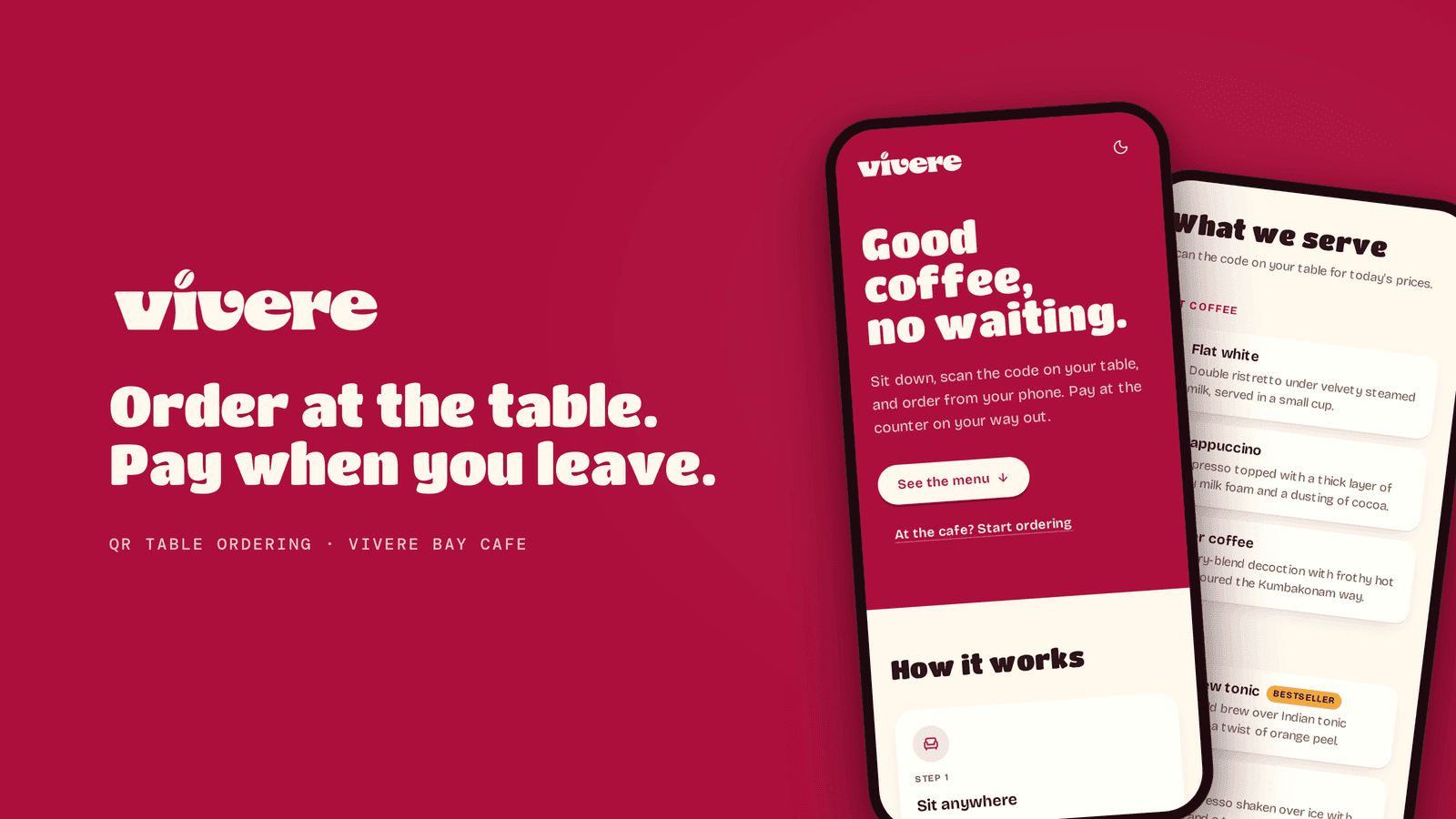
Vivere Bay Cafe wanted guests to order from their table and pay on the way out, the way they would with a waiter. The owner asked us for a working proof of concept of the web app. Guests open it from the QR code on their table and order in rounds onto one bill for the table. Staff follow those rounds on a live board, on their phones and on a tablet at the pass, and the owner looks after the menu from an admin console.
Once the ordering side worked, the owner asked for something that isn't food. They wanted to sell a yearly cup, engraved with the guest's name and kept at the cafe. More ideas like it were likely to follow, so instead of a one-off cup product we built a small membership system, and the cup became its first plan.
This is a proof of concept and it hasn't been through a real service yet. The guest side is deployed and opens in any browser, which is where every screen on this page comes from. The staff board and the admin console need a sign-in, so they aren't shown here. Some of the rules below will probably change once real tables use it.
The rules a pay-when-you-leave system has to settle are written up on the blog, along with how the engraved cup turned into membership plans and how Postgres enforces the whole thing.
A lot of QR ordering takes payment before the kitchen sees anything. Each order is a small closed transaction and nobody shares it. That wasn't what this cafe wanted. A table orders coffee, then a sandwich twenty minutes later, then something for the friend who turned up late, and expects one bill at the end.
So the thing being built is a shared bill that can stay open for an hour or more, with several phones adding to it. Two of them might tap Request bill at once. Two servers might confirm the same payment, and a guest on weak signal might tap Place order twice. Each of those needed a written answer before any code did.
Every cafe also gets the occasional table that leaves without paying, or a round ordered by mistake. If the only way to close a tab is to record a payment, staff will record a fake cash payment to free the table, and the day's cash total stops matching the drawer.
We wrote the rules down before building, one line per situation, and then put them where none of the apps could skip them. Most took a line to agree on. A few took longer, like when the bill locks and who confirms a payment.
Guests don't have accounts. Whoever scanned a table's code is a guest at that table. A table has at most one open tab and every order is a round on it, labelled like "Phone 2" so staff and the table can tell rounds apart. Split bills are on the parked list.
Request bill freezes the tab, so the total a guest sees is the total the server collects. An order placed after that is refused with a message to ask the server, and the cart stays on the phone. When a server confirms, the amount on their button has to match the current bill.
The guest picks cash, card or online payment at checkout, and online payment shows a link with the exact amount filled in. In every case a server confirms the money arrived before the tab closes. A payment gateway was left for a later stage, and when it arrives it will confirm the same tab the same way a server does.
Row-level security lets guests read their own table's tab and lets staff read everything. Nobody can insert or update tabs, rounds or payments from the browser. About a dozen security definer functions check who's calling, apply the rule and write, inside the transaction that makes the change.
A Supabase Realtime event only tells a screen to reload what it's showing, after a 150ms debounce, so a round with five items causes one reload. Screens also reload when the channel reconnects and when they become visible again.
When the cup request came in, a plan became a menu item with a validity period and perks filled in. It sells from the same menu, goes on the same bill and gets paid at the counter, so the cart, staff confirmation and the dashboard barely needed to know memberships existed.
Friends who scan the same table's code join one tab. Each phone's orders show as its own round, and the bill is every round added up.
Each table's QR carries its own code, and guests never see another table's. The generic menu link only offers tables with nothing going on, so a busy table is joined by scanning its code.
Once someone taps Request bill, the tab stops taking orders. If two phones tap it, the first counts and the second sees "Bill already requested".
Cash, card and online payments all close the tab only when a server confirms them. If the bill changed in between, the confirm fails and asks them to check the new total first.
New rounds and bill requests reach staff phones and the tablet at the pass with a two-note chime and a vibration where the device supports it. Two taps on the same ticket move it one step.
A round ordered by mistake can be cancelled, and the bill drops. A table that left without paying is closed as unpaid, which frees it with no payment attached.
Any menu item can be marked as a plan in the admin console, with a validity period, a discount on the bill, free items, and a line saying what the cafe has to prepare. The engraved yearly cup was the first.
Memberships belong to a phone number. The phone that bought a plan attaches it to the next order on its own, and anyone else can type the number. Free items are marked by a server, so a member can save one for another visit.
Rounds keep the price they were placed at, and memberships keep the terms they were bought under. The owner can change a price during lunch without touching rounds already placed.
It's one Next.js 16 App Router app, with route groups for the guest, staff and admin apps. Supabase provides Postgres, auth and Realtime. The ordering rules live in Postgres functions, so every app goes through the same ones.
Opens from a table's QR code. Opening a table link signs the phone in as a Supabase anonymous user, so every guest has a user id and nobody creates an account. The phone sends item ids and quantities, never a price, plus a key that makes a repeated order safe.
Staff sign in with their name and a PIN, which also unlocks the browser's audio for the new-order chime. Rounds arrive as tickets that move forward one step at a time. A server confirms each payment from a button that shows the amount being accepted.
The owner signs in with email to edit the menu and prices and to set up membership plans. A members page lists who bought which plan, when it runs out, and whether the cup has been handed over yet.
Reads go through row-level security, and writes go through functions such as place_round, request_bill and confirm_payment. A partial unique index allows one open tab per table. Tax is worked out in one function that every total comes from, and column grants keep phone numbers out of guest reads.
Two phones place the first order for an empty table at the same moment.
A partial unique index allows only one open tab per table, but on its own it would hand the second guest a constraint error. So place_round first takes a transaction-level advisory lock on the table. The two orders queue up, the first opens the tab, and the second finds it and becomes round 2.
A guest on weak signal taps Place order, sees nothing happen, and taps again.
The phone makes a UUID when the order sheet opens, and place_round checks it against a unique column before doing anything else. The second tap gets back the round that already exists, so the kitchen sees one round. Opening the sheet again makes a fresh key, so a second order placed on purpose still goes through.
Two servers confirm the same bill, or tap the same ticket, at the same time.
confirm_payment locks the tab row with select for update, checks the tab can still be paid and that the amount matches the current total, and only then records the payment. The second confirm waits for the lock, finds the tab closed and is told the bill is already closed. advance_round takes the status the server's screen was showing and refuses if the round has moved on, so a double tap can't skip a ticket from New to Ready.
Supabase Realtime doesn't replay events to a device that was asleep or offline when they happened.
Events only trigger a reload. Each screen also reloads when its channel subscribes, which includes every reconnect, and when it becomes visible again, so a tablet that slept for ten minutes catches up the moment it wakes. A Playwright test takes the staff browser offline, places an order from a guest phone, reconnects, and expects the ticket to appear.
Guests can read their own tab, and the tab holds the phone number and name given at checkout.
Column-level grants let clients select every column of the tabs table except the phone number and guest name, and staff read the number through a function that checks they're staff. We checked on the hosted project that Realtime applies the same column privileges to what it sends, and the publication lists only the safe columns of the members table in case that ever changes.
Tell us about your project. Notchip scopes, designs, and ships on a milestone basis — you only pay for results.
Start a project